A compressor store built so that people order from it
The company sells car compressors, tire repair kits and sealants. We built it a store: a catalog where the buyer finds what will fit their car themselves, a page for every product, ordering with no registration, and a control panel where the owner changes prices and availability without us.
Build an online store
for car compressors.
The company sells compressors, tire repair kits and sealants. It needed a site where these goods are visible, clearly described and can be ordered.
Twenty-one products in three categories, a page for each of them, a cart and checkout, a control panel for the owner and a notification about every order.
Five solutions
the store rests on.
We showed what people really go by
Wheel size and pump power are brought out onto the product card and into the table of specifications. The buyer sees right away whether a kit will be enough for their wheels, and understands why two sets that look alike cost differently.
We took away the extra choosing
Three categories in one row at the top instead of side filters: kits, compressors, sealants. The make of the car stayed as a label of origin, not as a filter. One product out of twenty-one really is limited to a make, and that is written in orange right on its card.
Ordering with no registration
Name, phone, city and post office branch. There is no account to create. Anyone in a hurry presses “Buy in 1 click” and leaves just the name and the phone, and the address is settled when the order is confirmed. Payment on delivery, and that is written right on the form, in front of the buyer.
Every product has a page of its own
Its own address, its own heading, its own description, a picture for messengers and the price in a form machines read. You can send a buyer a link straight to the kit they need, and a search engine sees each product separately.
The store stays under the owner's control
The owner changes prices, availability, photos and the order of the products in the panel on their own. Every order arrives in Telegram as a full list: what was ordered, for how much, the name, the phone, the post office branch.
The catalog, the product page
and the specifications.
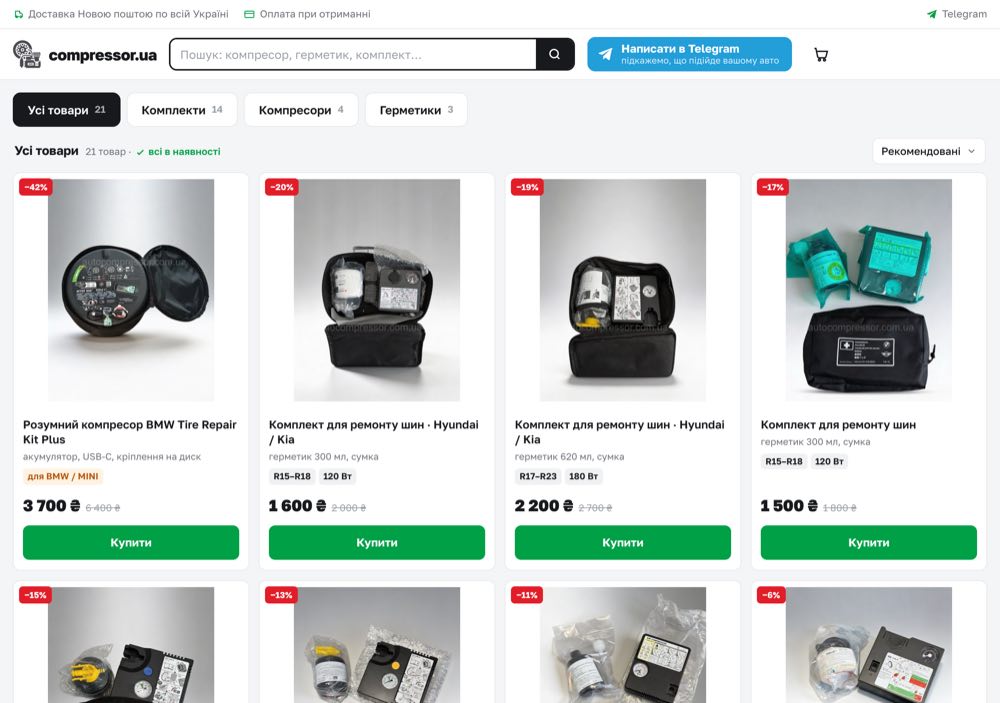
The catalog
Categories in one row, how many products are in each of them and a mark for availability. The card shows the wheel size, the power and the price with the discount. The product with a restriction by make is labeled in orange, the rest fit any car.
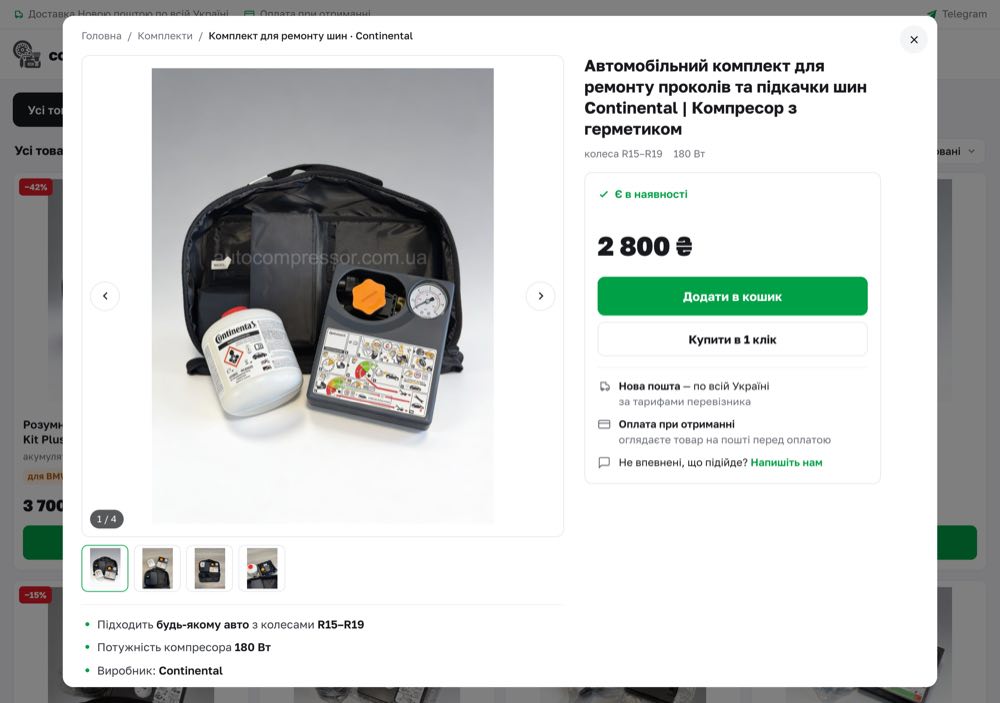
The product page
Everything needed for a decision on one screen: photos you can switch between, the price, availability, short points about who it suits, and next to them the delivery and payment terms. There is no going to another page for those.
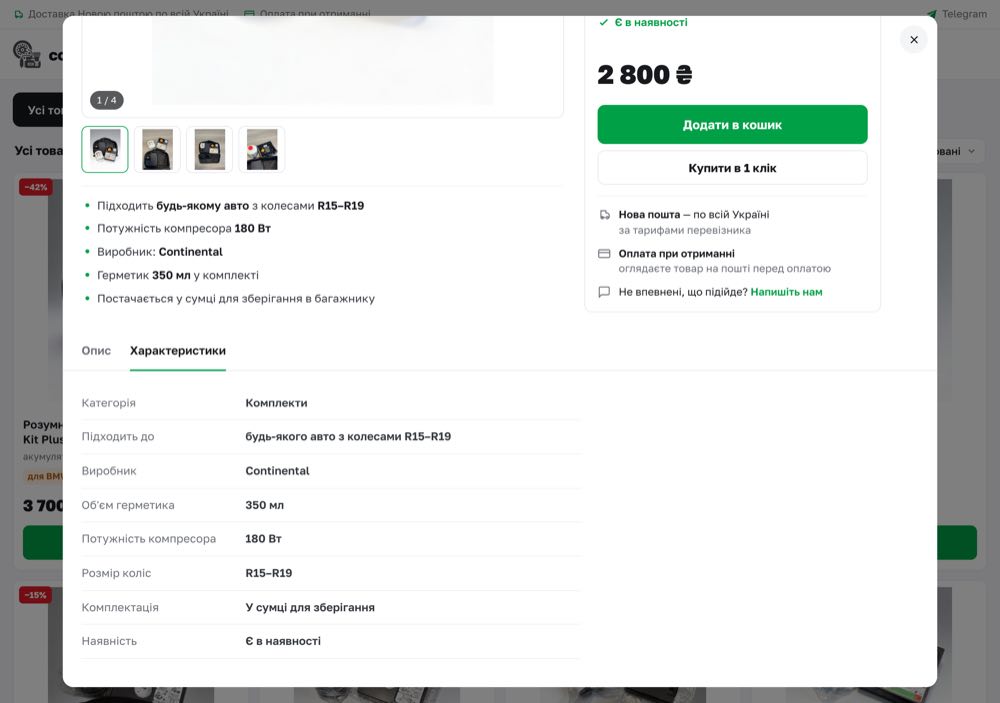
The specifications
Who it suits, the manufacturer, the volume of sealant, the power, the wheel size, what comes in the set. The table answers the question “will it fit mine?” right on the product page.
A store has to sell
and stay in the owner's hands.
We start from how a person chooses
First we figured out what people really go by when choosing these goods, and only then drew the card. The catalog is built around the question the buyer cannot answer for themselves.
We remove everything standing between the buyer and the order
Registration, needless fields, a mandatory phone call, hunting around the site for the delivery terms. Every step like that costs an order, so there are none here.
We hand the controls to the owner
Prices and availability change every week. If every edit means writing to a contractor, the store freezes in the shape it was handed over in. That is why the control panel is part of the job from the start.
The store does not sell by its catalog,
it sells because ordering from it is easy.
The question “will it fit my car” is settled on the page
It used to be answered by a salesperson in chat. Every conversation like that took time — and took some of the buyers who did not get an answer right away.
The order arrives as a finished list
What was taken, for how much, where to send it — all of it in Telegram at once. The owner does not call back to find out what the person meant.
A product that is out of stock disappears the same day
The owner changes prices and availability themselves. The buyer does not order something that is out of stock and does not get a call saying “sorry, we have run out”.
In the first six months after launch there were 20–30% more orders.
The same works for more than compressors
Any goods that are shown in chat right now and picked out in words can be put together into a store where a person chooses for themselves and leaves an order at two in the morning. Tell us what you sell and we will show you what it would look like.