Grid Monitor — our own device that watches the power
A small device sits at home, runs off an outlet and watches the line voltage. The moment the power goes out or comes back, it sends a Telegram message about it. We built the whole of it: the firmware, the bot inside the device, the product site and the manual a person sets everything up with on their own.
Noticing that the voltage is gone is easy.
Telling someone about it is harder.
Any appliance plugged into an outlet goes dark together with the power. This one has to do the opposite in that same second: get online and send a message. That is, work at the point when there is no power any more.
Then it has to reach the internet, which went away together with the power, not lose the event, calculate the real length of the outage — and not ruin its own battery if the power is off for a day or longer.
Four solutions
the device rests on.
It lives longer than the blackout
Its own battery and up to a day of running with no power. If the outage drags on, the device goes to sleep carefully so that a deep discharge does not ruin the battery, and wakes up by itself when the power comes back.
The bot lives inside the device itself
The simplest way would be to put a middleman in: the device reports to a server and the server sends the message to Telegram. Then the owner would be paying for that server every month, and the system would gain one more place that can go down. We made it so that the device sends the Telegram message itself.
Events do not get lost
During a very long blackout the device switches itself off to save the battery, and switches on again when the power comes back. The home Wi-Fi goes away together with the power too. The queue of events sits in the kind of memory that survives a loss of power, so not a single message is lost, and the length of the outage is counted by the device's own clock.
Set up by someone who does not want to figure it out
The device brings up a network of its own and shows a setup page — no apps at all. The Wi-Fi can be changed without a reset, and everyone already connected stays where they are. The setup window only appears while there is power: otherwise it would eat the battery exactly when the battery is needed.
The bot in Telegram,
the device itself and its site.
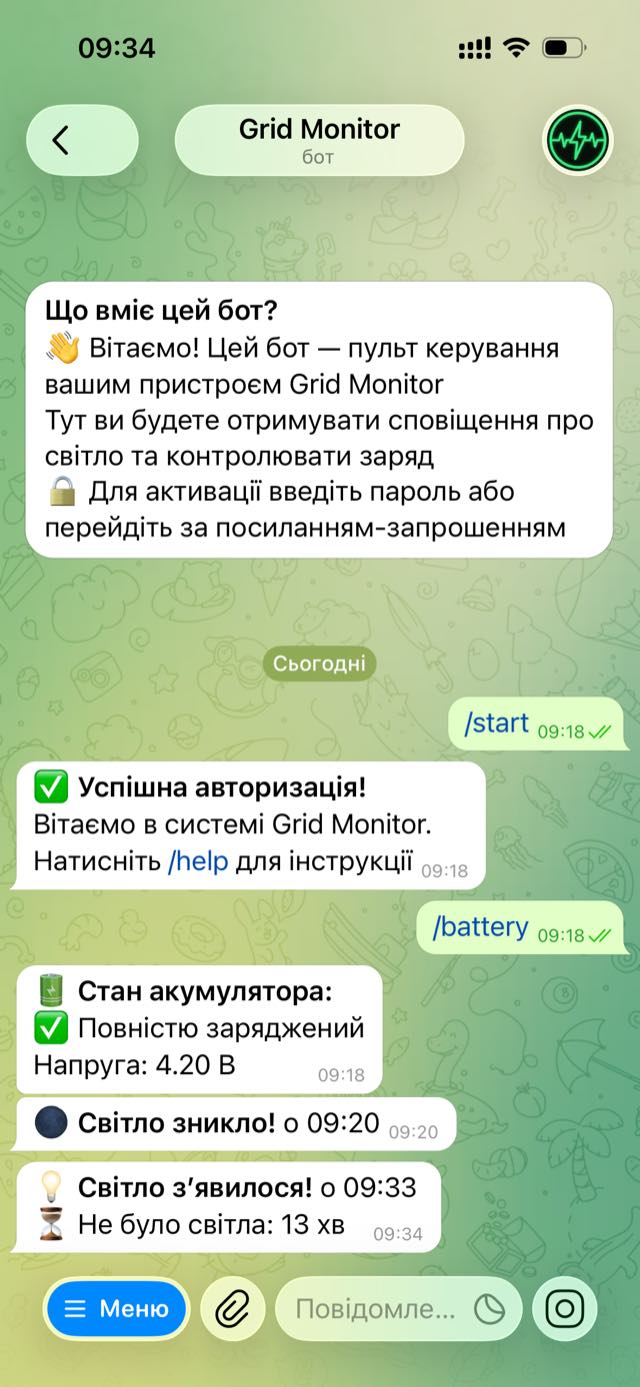
A real outage
The bot messaged on its own that the power went out at 09:20 and came back at 09:33, along with how long it lasted. Above that — the battery charge on request.
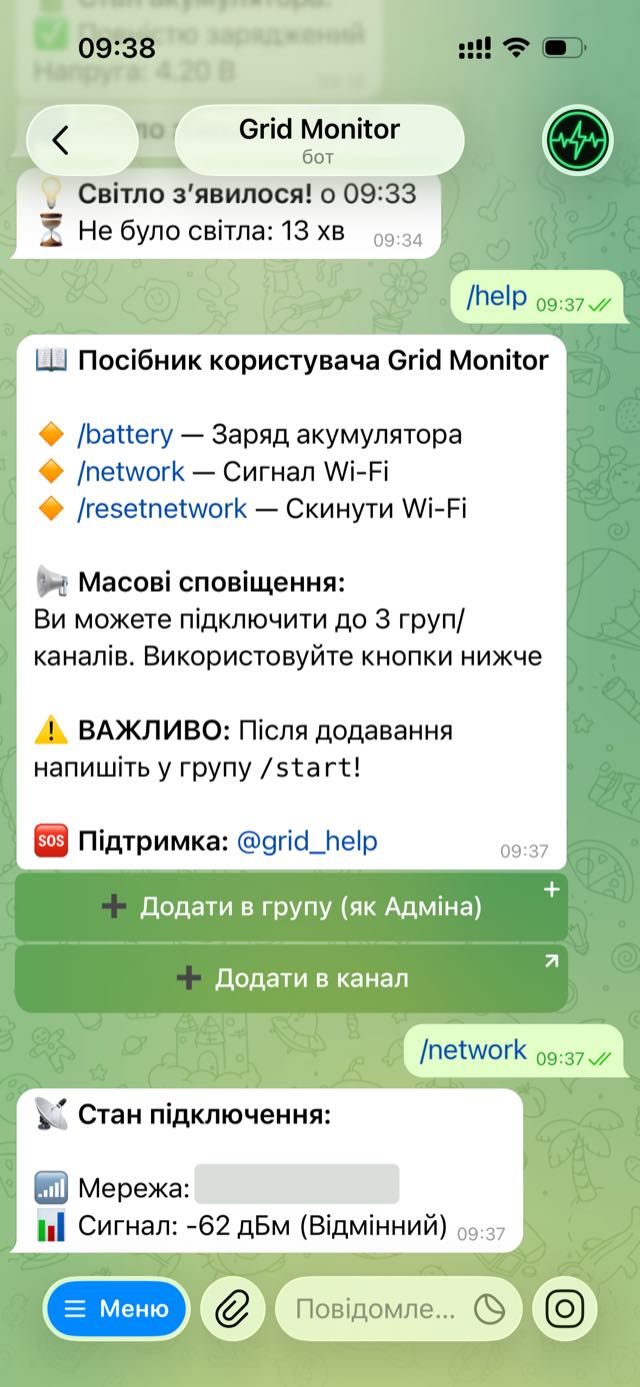
Help and the state of the connection
The /help command shows the buttons for adding the bot to a group or a channel. /network — the quality of the Wi-Fi signal. We blanked out the network name in the screenshot.
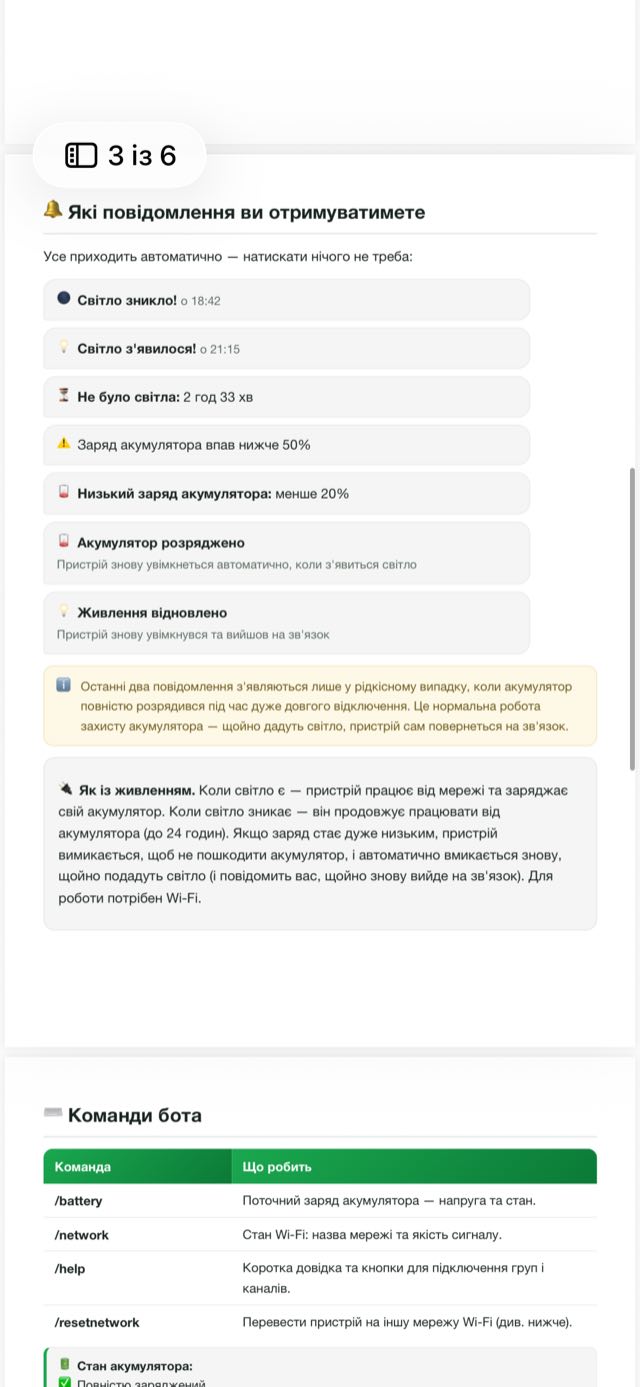
The manual that comes with the device
Six pages: setting up in two steps, which messages arrive, the bot's commands and what the color of the indicator means.
The device
The case, a power switch on the side, USB-C and one LED. In the box — a power supply and a cable; there is nothing else to buy.

The product site
The job did not end with the device itself: it also had to be described so that a person gets it within one screen. grid-monitor.net brings together the explanations, what comes in the box, the specifications and answers to questions.

We take a product to the point
where it can be used without us.
We take on the whole job
The firmware, the bot, the site and the manual were made by one team. The client does not have to bring four contractors together, wait for one of them while another finishes, and listen to which of them is to blame.
We do not leave a subscription fee behind us
Where a rented server can be done without, we do without it. Not because that is easier for us — it is harder. It is that otherwise the client pays every month for something that should have been bought once.
We think about what happens later
The Wi-Fi password changed, the internet went away, the device rebooted, the outage dragged on well past a day. These are everyday things that happen every week, and the device has to live through them without us stepping in.
We test in real conditions
The device lived through real outages: with the internet dropping, the router rebooting and long blackouts. That is where things showed up that you never see on a desk by flipping off a power strip.
The same works for more than power
Anywhere somebody has to look in and check from time to time, that job can be handed over to a program. Whether a request came in, whether the stock ran out, whether all is well at the warehouse: the program checks on its own and messages you. Tell us what you have and we will show you what it would look like.